Atmos
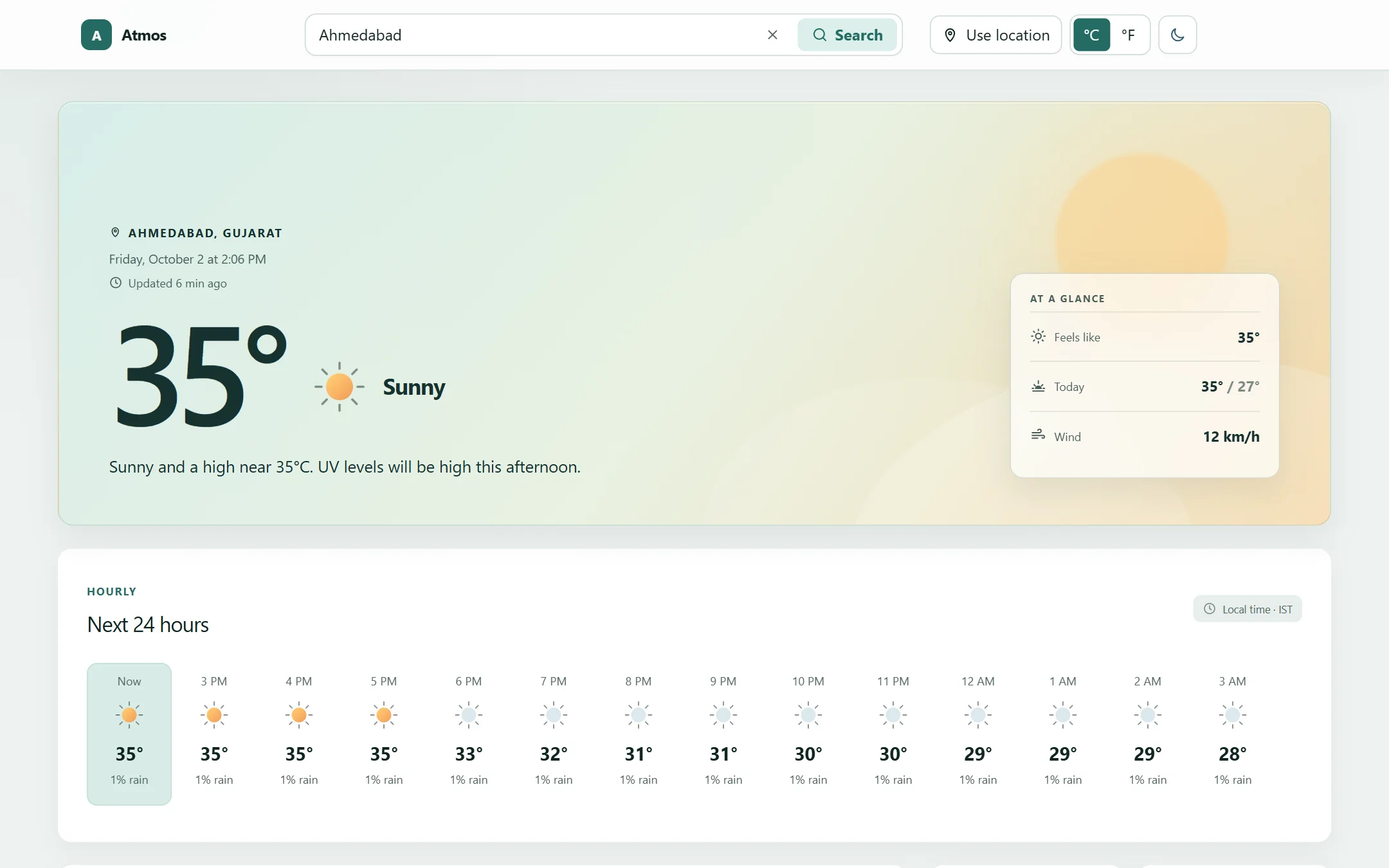
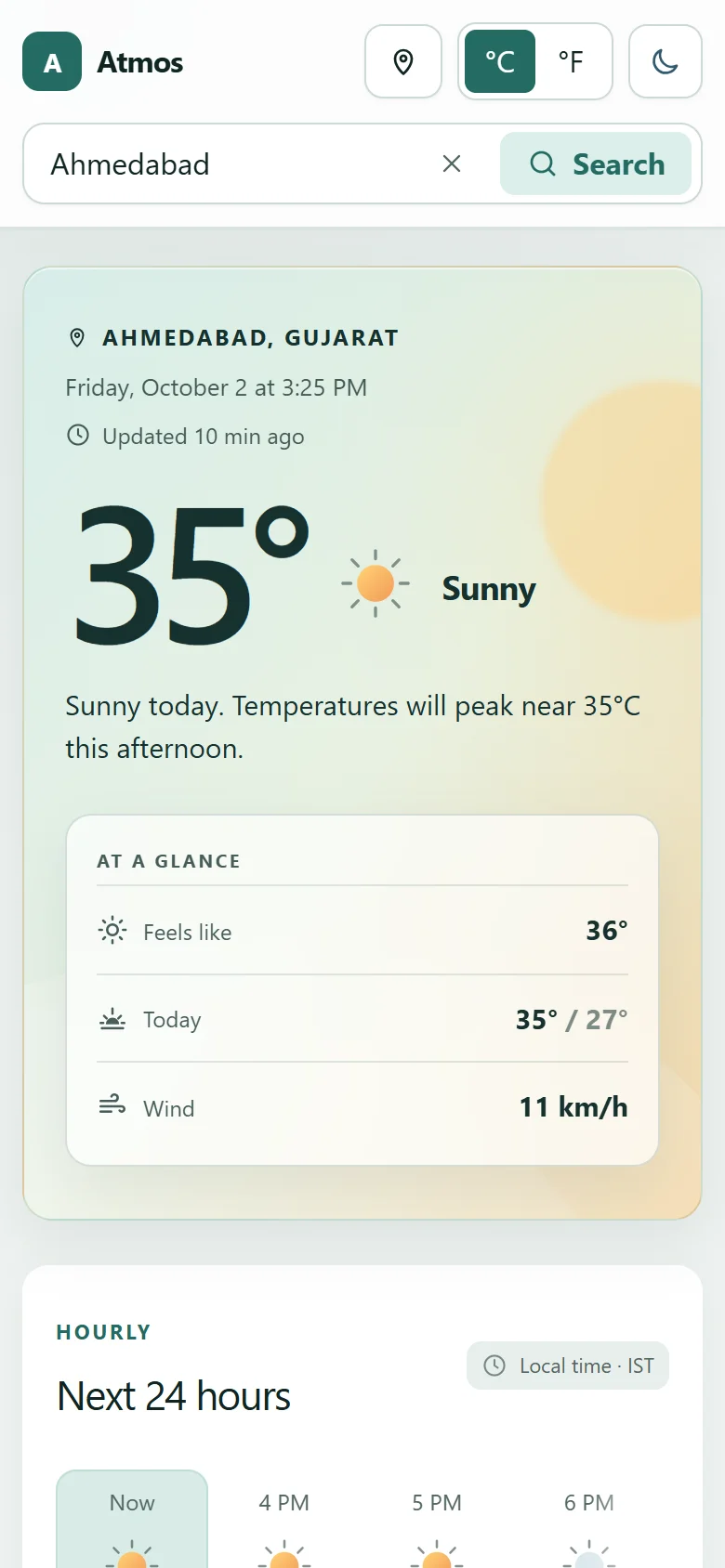
Atmos is a weather app organised around the decisions people make with a forecast: whether to take an umbrella, when it will be hottest, what the week holds.
Atmos began as a weather app I built in 2023. In 2026 I rebuilt it as a new app.
- Role
- Interface design · Frontend engineering
- Year
- 2026
- Team
- Solo
- Stack
- Next.js · TypeScript · Tailwind CSS · WeatherAPI.com
Overview
- Problem
- Weather apps tend to lead with a grid of numbers. Temperature, humidity, wind, UV, and rain chance compete for attention, and the reader has to work out what they mean for the day.
- Approach
- I put a one-line summary at the top, then current conditions, the hourly forecast, and the 10-day view, with detailed metrics after. Underneath, every response is validated, cached, and rate-limited.
- Result
- A live app with city search, optional location, weather alerts, °C/°F switching, and a 10-day forecast.
Decisions
D1Lead with a sentence.
Why: People check the weather to decide something. The summary answers the common questions in words: if rain is likely, it suggests keeping an umbrella nearby; on a high-UV day, it says so; otherwise it gives the afternoon high.
Trade-off
The summary is rule-based and covers only those three cases. Anything subtler is left to the hourly and daily detail below it.
D2Keep the provider behind the app’s own API.
Why: The browser only calls the app’s weather route. It checks the city and day range, applies a per-visitor rate limit, gives the provider eight seconds to respond, and turns provider errors into plain messages, such as a misspelled city.
Trade-off
Every request makes an extra hop. The built-in rate limiter lives in each server instance’s memory, so production relies on a platform firewall rule as the primary limit.
D3Validate before rendering.
Why: Each response is checked at runtime against every field the interface reads, from numbers that must be finite to hourly entries and alerts. An incomplete response becomes a clear error instead of a half-drawn page. The validator has its own tests.
Trade-off
The validator has to be updated whenever the interface starts using a new field from the provider.
Three layers of caching
Forecasts don’t change minute to minute, so Atmos avoids asking for the same one twice.
Server
Provider responses are cached for ten minutes per location, and shared caches may serve the previous copy for up to five more while a fresh one loads.
Browser
The five most recent locations are kept in memory and local storage for ten minutes, so returning to a recent city doesn’t need a new request.
In flight
If the same forecast is requested again before the first response arrives, both callers share a single request.
Storage is optional. If the browser blocks it, the app still works, only without memory between visits.
Outcome
What shipped
- A one-line summary of the day
- City search that remembers the five most recent cities
- Opt-in location: the browser asks first, and the app never guesses a city from an IP address
- Hourly and 10-day forecasts
- Weather alerts when the provider issues them
- °C/°F switching
- Security headers, including a content security policy