Aayushya Group
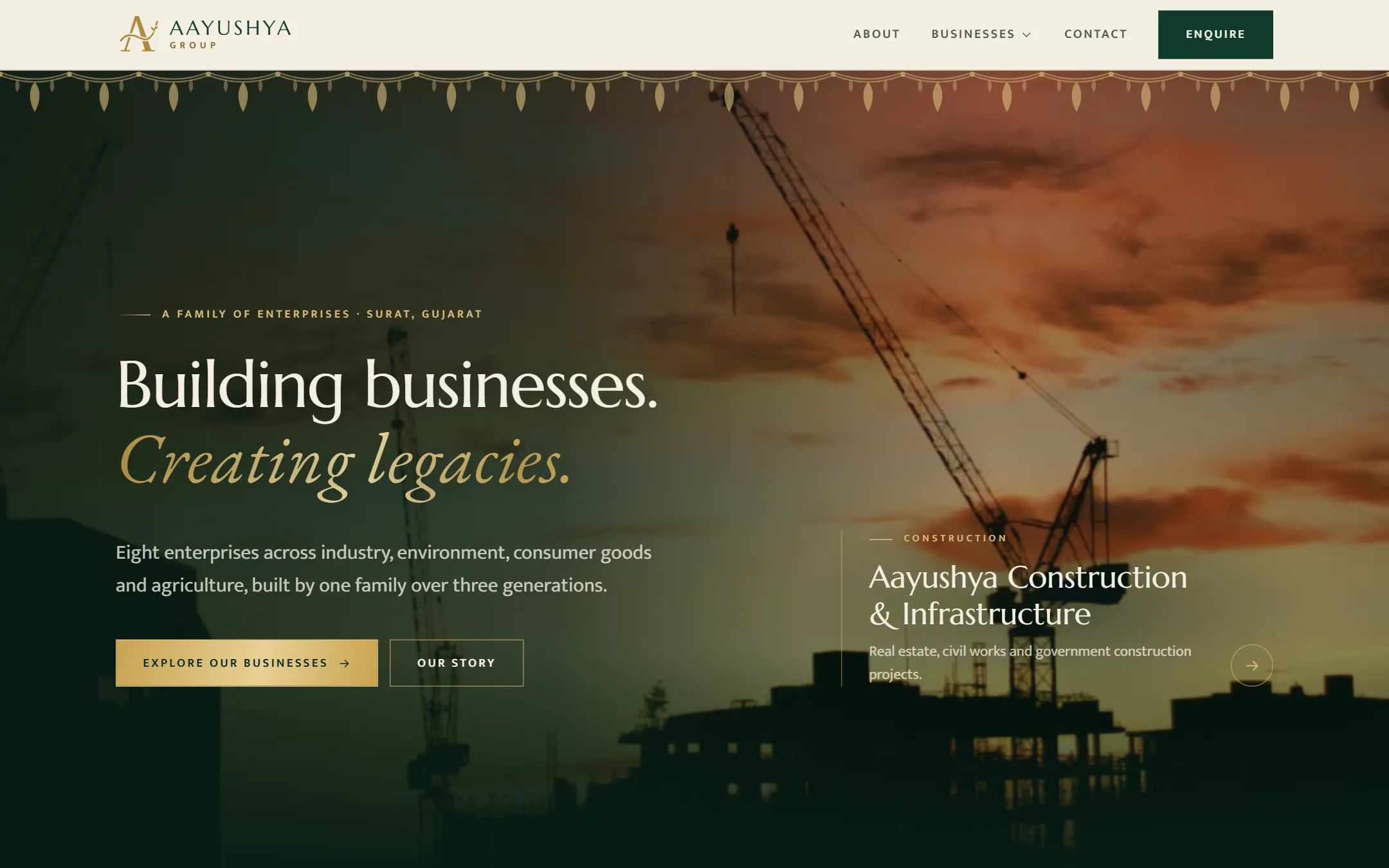
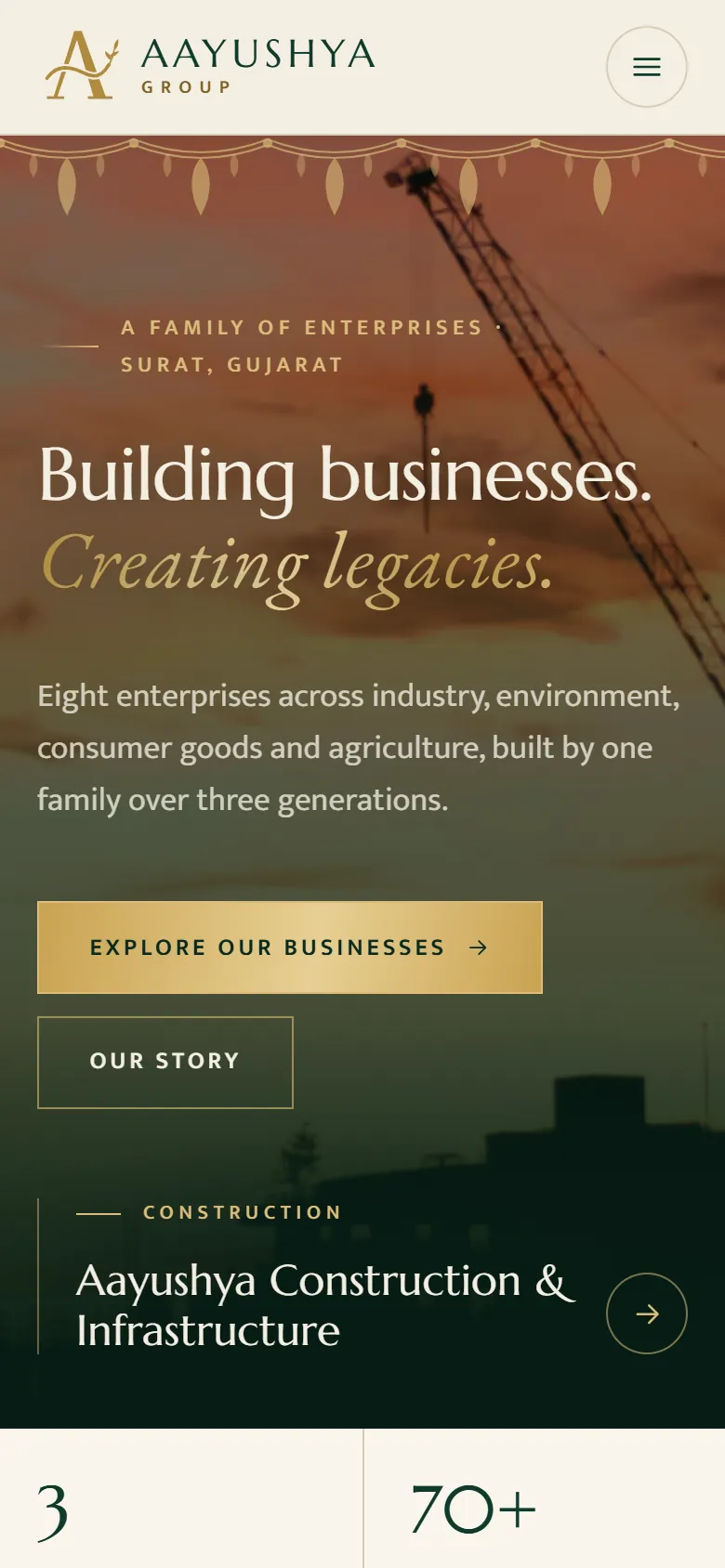
Aayushya Group is a family business house from Surat with eight businesses across engineering, construction, chemicals, consumer goods and agriculture. Its website gives each business a home and every visitor a direct route to the right one.
A client project, built for real use.
Aayushya is a Sanskrit word for long life.
- Role
- Web design · Frontend engineering
- Year
- 2026
- Team
- Solo, for the client
- Stack
- Next.js · React · Tailwind CSS · GSAP · Lenis · Web3Forms
Overview
- Problem
- Eight businesses share a family name and little else: a foundry, a construction company, two chemical companies, cookware, a mango farm, personal care and food. Each has its own customers, and most visitors arrive looking for one of them.
- Approach
- I built the site around the group first and the businesses second. The home page tells the family’s story and introduces all eight; every business page then follows one template, chemical products get their own specification pages, and every page ends in an enquiry for the business it describes.
- Result
- A 22-page site for a real client: 8 business pages, 8 product pages, and structured data throughout.
Decisions
D1Group first, then the business.
Why: The home page introduces the family and all eight businesses before any one of them. Every business page then follows the same order: at a glance, what it offers, who it serves, common questions, and how to enquire, so a visitor who has read one page can read them all.
Trade-off
All eight share one visual language, so a foundry and a personal-care brand look like members of one family rather than brands of their own.
D2One enquiry form, routed by business.
Why: Visitors choose the business they need, and links from a business or product page arrive with it already chosen. A product link also writes the first line of the message, such as “I’d like to know more about Bromine.” A “Not sure which business you need?” tile covers everyone else.
Trade-off
Enquiries go through a hosted form service rather than the site’s own server: no backend to run, but one more service to depend on.
D3Motion that steps aside.
Why: GSAP animates the page as it scrolls and Lenis smooths the scrolling itself, giving a seventy-year story an unhurried pace. When a visitor’s device asks for reduced motion, smooth scrolling switches off and most content appears without animating in.
Trade-off
The animation libraries add JavaScript to every page of a site whose content is otherwise static.
Built to be found
A business group is found through search and shared links, so every page describes itself to both.
Metadata
Each page has its own title, description and canonical URL, and business and product pages generate their own share preview image.
Structured data
The group is described as an Organization. Business pages add breadcrumbs and their FAQs; product pages add the product with its specifications.
Sitemap
A sitemap lists all 22 pages.
Lighthouse scores 100 for accessibility and best practices on the home page and a business page.
Outcome
What shipped
- A home page that tells the group’s story, from the family mango farm to eight businesses
- An interactive family tree whose branches open each business, set as a list on phones
- Eight business pages from one template: at a glance, offerings, who they serve, FAQs, and an enquiry
- Eight product pages with applications and specifications for the two chemical businesses
- An enquiry form that arrives with the business, and the product, already filled in
- About, privacy policy, and terms pages